

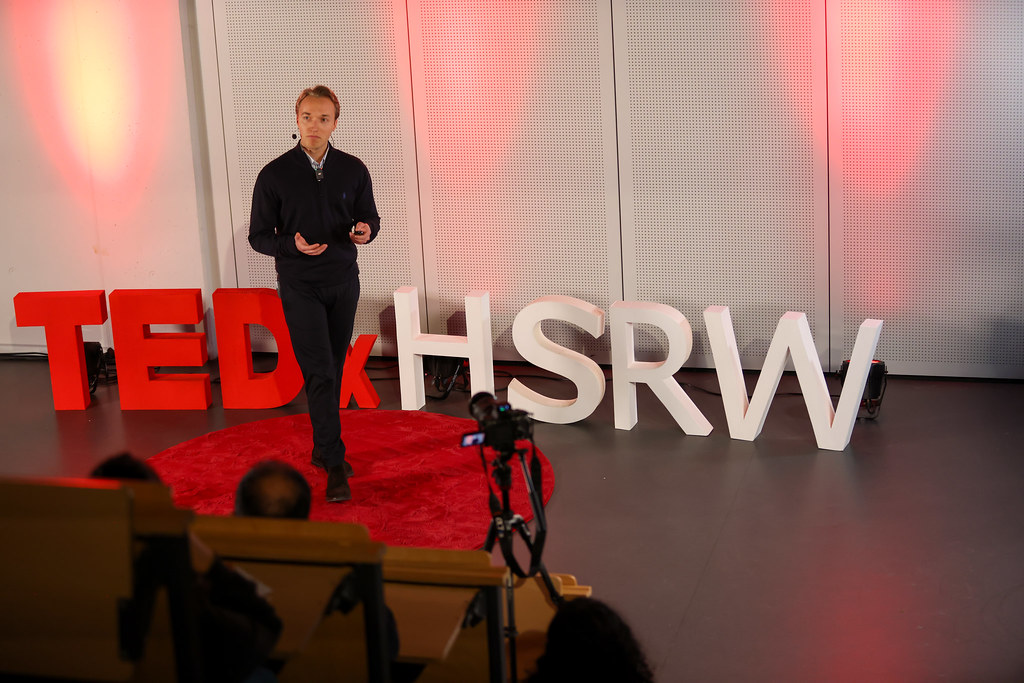
Giving a TEDx Talk sounds glamorous from the outside. In reality, it’s a very specific kind of challenge: one clear idea, told through one clear storyline, delivered to a mixed audience, in a tight time frame.
That’s what makes TEDx such a powerful format for public speaking. It forces you to stop hiding behind “more content” and start asking the real questions:
- What’s the message?
- What’s the emotional arc?
- What will people remember tomorrow?
For my talk, the anchor was a personal mentoring story I’ve lived through. Not because “personal” is trendy, but because a real story is the fastest way to make an idea understandable for people with completely different backgrounds.
And then came the hard part: turning that story into a talk that works for everyone in the room.
1) The Storyline Comes First (Before Slides, Before Style)
A TEDx Talk isn’t a lecture. It’s a story that carries an idea.
I started with a mentoring moment where I saw something I’ve been noticing more and more: many early-career professionals are ambitious, talented, driven… and still feel strangely disoriented. Not because they’re lazy. But because change is faster than clarity.
New AI tools. New expectations. Endless options.
And underneath that: a quiet fear that’s becoming more common than we admit.
If AI keeps getting better, what can I still contribute?
That tension became the “why” behind the talk. From there, everything had to serve the storyline: setup, conflict, insight, resolution.
2) Coaching Helped, but Feedback Loops Made the Talk Sharp
Yes, we had support:
- a coach (which genuinely helped),
- and the TEDx team at HSRW who gave feedback on the script and structure.
That support gave me a framework and outside perspective.
But the biggest improvement came from something much more “everyday”: rehearsing with friends and letting them be brutally useful.
I asked them very specific questions:
- “Where did you lose me?”
- “What sounded good on paper but weird out loud?”
- “What’s unclear or too abstract?”
- “What’s repetitive?”
- “What word would you use instead?”
- “If you had to summarize my idea in one sentence, what would it be?”
Sometimes their feedback was surprisingly practical:
- “On that slide, you could show this instead of saying it.”
- “That term feels academic. Use a simpler one.”
- “Make this part more visual.”
That’s where talks get good: not in your head, not in your first draft, but in the loop between speaking, listening, cutting, and rebuilding.
3) From Script to Speech: Repetition Creates Freedom
At the beginning, you’re glued to the text. You’re busy remembering the exact wording.
But if you keep rehearsing, something shifts.
You stop thinking about the next sentence and start thinking about:
- pauses,
- pacing,
- eye contact,
- gestures,
- emphasis,
- how the audience feels in the moment.
That’s the point where it becomes less “reciting” and more telling a story like a human being.
And honestly: that’s where TEDx pushed me the most. The format doesn’t forgive blur. It rewards clarity.
4) The “Two Rooms” Concept: Technology Room vs Compass Room
One of the best decisions I made was using a simple visual framework: Two Rooms.
- The Technology Room: tools, speed, productivity, optimization.
- The Compass Room: values, judgment, identity, direction.
This helped in two ways:
- It made AI less abstract.
Instead of debating “AI” as a concept, you can ask: Which room am I in right now? - It made the mentoring story universal.
In mentoring conversations, I’ve seen people stuck in the Technology Room: chasing better tools, better systems, better outputs… while losing the Compass Room: What matters to me? What am I aiming for? What kind of person do I want to be?
That framework gave the audience something they could remember, repeat, and use. And in a TEDx Talk, that matters more than sounding smart.
5) Slides: Less Is More (Because the Talk Is the Main Act)
I kept slides minimal on purpose.
Not because slides are bad, but because TEDx isn’t a slide presentation. Slides should support understanding, not carry the message.
My rule was simple:
- If I need to explain the slide, it’s the wrong slide.
- If it distracts from the storyline, it’s noise.
- If it doesn’t make something clearer or more emotional, cut it.
What TEDx Gave Me (Beyond the Stage)
Public speaking is often framed as performance. TEDx taught me it’s more about translation.
Translation of:
- your experience into a story others can enter,
- your idea into language that different generations can understand,
- your knowledge into something memorable.
And if you’re building your own speaking style: yes, watch other speakers. Get inspired by structure, rhythm, storytelling techniques.
But don’t copy the “TED voice.”
The point isn’t to sound like a TEDx speaker. The point is to sound like you, with sharper clarity.
My Big Takeaways (If You’re Working on Public Speaking)
- Start with one idea, not ten.
If you can’t say it in one sentence, it’s not ready. - Storyline beats information.
People remember stories, not bullet points. - Rehearsal is where the talk is written.
Your first draft is only a hypothesis. - Feedback needs structure.
Ask precise questions like “Where did you lose me?” - Make your message visual.
Frameworks like “Two Rooms” turn abstraction into something people can carry home. - Authenticity isn’t a vibe. It’s clarity + consistency.
Be yourself, but be your clearest self.
Add-on: Why Your Talk Will Never Be Perfect (and Why That’s the Point)
Here’s the part nobody really tells you when you prep a TEDx Talk: perfection is a moving target.
If you’re someone with high standards (same here), you’ll automatically see every tiny weakness:
the pause that felt too long, the sentence that could be cleaner, the gesture that looked awkward, the slide that could be stronger, the one metaphor you could’ve explained better.
And yes, that standard is also a strength. It’s the reason you put in the work.
But it becomes a trap when you start believing the first version has to be the final version.
Because the truth is:
Your first TEDx Talk won’t be perfect.
And honestly, it shouldn’t be.
Not because you shouldn’t aim high. But because you’re still becoming the speaker you’re meant to be. Especially when you’re young, you don’t have “40 years of stage experience” behind you. You’re learning in real time, and that’s not a flaw. That’s how it’s supposed to work.
What helped me was reframing perfection into something more realistic:
- Instead of “100% perfect,” aim for “clear + authentic + well-rehearsed.”
- Instead of “no mistakes,” aim for “the audience gets the idea and feels something.”
- Instead of “I must sound like a TED speaker,” aim for “I sound like me, just sharper.”
Because growth looks like iteration.
Your first video upload isn’t your best one.
Your first presentation isn’t your strongest one.
Your first sales-pitch isn’t your cleanest one.
Your first salary negotiation isn’t your smoothest one.
Your first date… is rarely a masterpiece either.
You improve by doing. You learn by shipping.
So yes: bring ambition, bring craft, bring discipline.
But at some point, you also have to accept a simple line that protects your confidence:
This talk isn’t the proof that I’ve arrived. It’s proof that I’m in the arena.
And that’s the real win.
Want to improve your public speaking, sharpen your storytelling, or build a talk that actually lands?
If you’re planning a TEDx Talk, applying for a speaking slot, or simply trying to get more confident on stage, I’m happy to help. I can give you straight, practical feedback on things like:
- your core message (what the talk is really about)
- storyline + structure (what to cut, what to keep)
- wording that sounds natural out loud (not like an essay)
- pacing, pauses, and audience clarity (“where did you lose me?”)
- simple frameworks that make your idea memorable (like my “Two Rooms” concept)
If that’s useful for you, send me a message. Tell me what you’re working on and where you feel stuck and I’ll point you to the next best step.